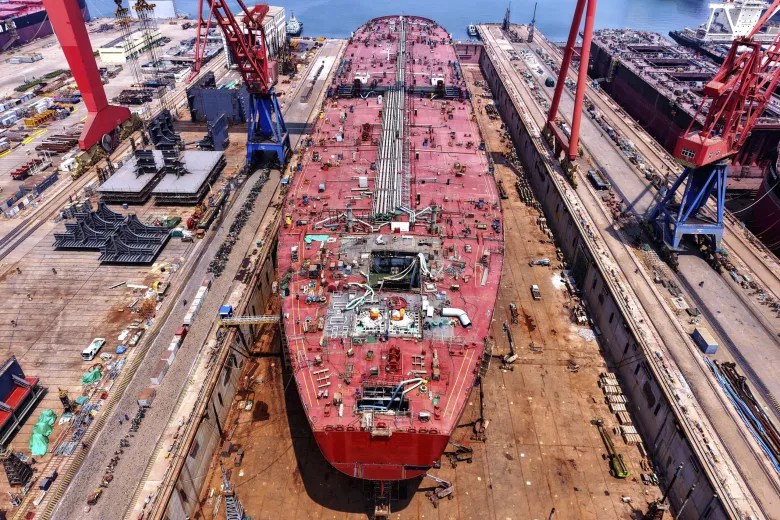
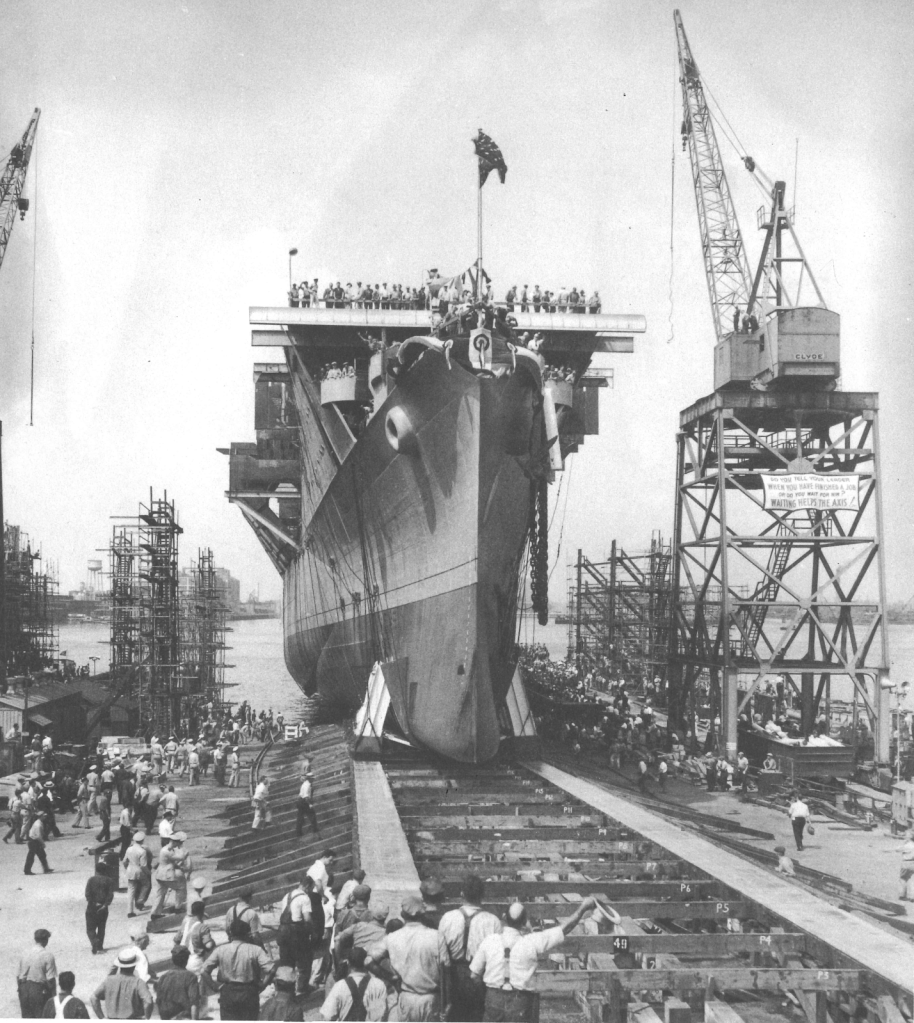
In 1943, the United States built a 441 foot cargo ship in just four days. In 2026, the United States has been working on one aircraft carrier for the past seventeen years.
At America’s shipbuilding peak during the second world war, American shipyards built thousands of vessels for the war effort, turning the United States into the Arsenal of Democracy. In the United States’ four year spell in World War II, American dockyards produced a staggering 5,000 major ships. The streamlining and speed of shipbuilding wasn’t just a songun-style militaristic upheaval but a true industrial shift.
This couldn’t be more contrary to the United States today.
Much like the rest of the United States’ industrial production, America produces barely a fraction of the world’s ships, while China and South Korea build the vessels that carry global trade itself. This shift couldn’t be seen more in the spotlight as the war in Iran shows how fragile the global maritime system truly is.
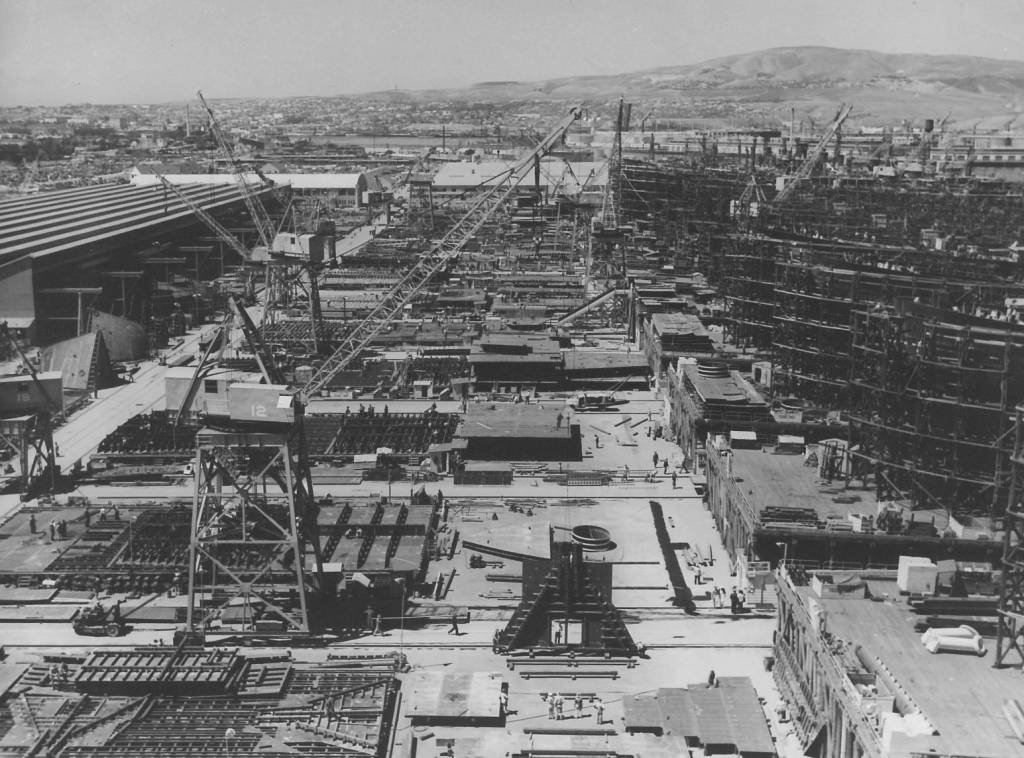
How did the U.S. fall so behind?
The American decline was the opposite of subtle.
While the United States only produces under 0.1% of global shipbuilding, its rival China produces 60% of worlds ships; almost 200 times American production. While South Korea: the nation that the United States’ industrial complex has been outsourcing shipbuilding to produces 20% of the worlds ships.
But what policies and actions took the Americans to this point?
This is not about pure economics. It is a reflection on a deeper structural shift. For decades after Americans came to feel largely out of danger, the United States moved away from industrial production toward a service driven economy, prioritizing finance, services, and technology. Shipbuilding & industrial production, once a strategic priority, has become an afterthought.
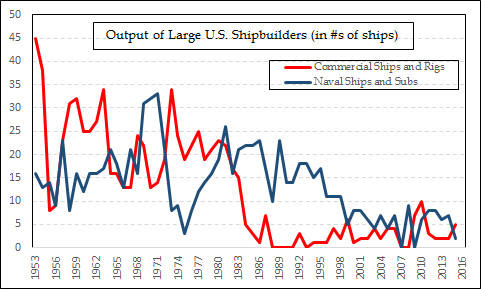
How did China come on top?
China’s hegemony on shipbuilding has not been a role they slipped into, it was laid out throughout Chinese five and twenty-five year plans since Jiang Zemin’s reign.
Through large scale subsidies, consolidations of domestic and foreign shipyards, and integration with it’s hard economic power from its belt and road initiative, China was able to build a system which dominates production. Tankers, bulk carriers, and container ships now largely come out of Chinese & Chinese-Owned yards.
South Korea pursued a different strategy. Instead of competing on volume, it specialized in complexity. Korean firms lead in Liquified Natural Gas carriers and other high tech, high maintenance vessels that are critical for energy transport in today’s world.
The division of labour on the ship-building front is clear:
China controls volume production.
South Korea controls specialized production.
The United States controls nothing.
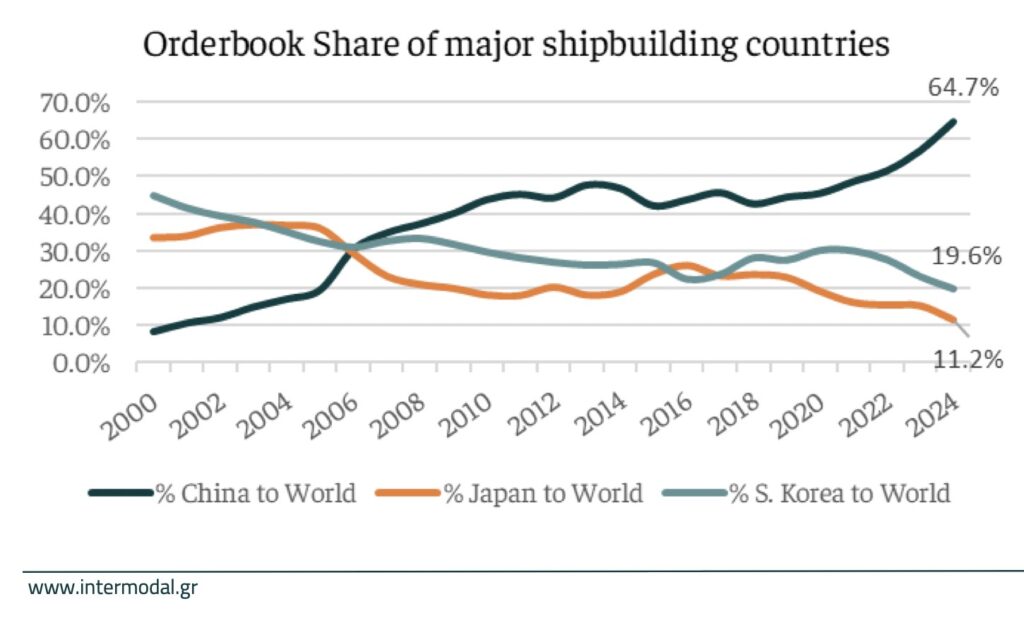
The Policy Decisions That Doomed The U.S.
The decline of U.S. shipbuilding was not something inevitable. It was completely policy driven. Three decisions in particular reshaped the American landscape.
Number 1: Trade Liberalization Without Safeguards:
In the early 21st century the United States was the unquestionably the world’s suzerain, free to roam into countries to further American goals without even asking permission. This led the United States to pursue an aggressive campaign of trade liberalization. First, America joined the World Trade Organization, which ensures lower tariffs, non-bias rules towards domestic suppliers, and guardrails on subsidies. Essentially a death sentence for domestic industrial strength, as well as a campaign of forced economic globalization the United States simply was not ready for. This unjustly believed all nations behaved in the extremely capitalistic market-driven production economics, whilst China was still a largely government backed system in said fields. Making it an uneven playing field. This also caused the loss of a lot of tariff protection which would allow the United States to keep chunks of production at home, and in a time where America can simply not stop alienating its allies, it may have really have proved useful. This allowed foreign, state-subsidized shipyards to become much cheaper for shipbuilding companies. This also caused the Industrial Clustering Effect, once production moved; experts, suppliers, and engineers moved with it, completely decapitating the potential of quick rebuilding even if it was wanted.
Number 2: Complete Lack of Comprehensive Industrial Policy
The U.S. didn’t just avoid subsidies. It ignored strategy in a sector that structurally requires it. The United States treated shipbuilding as a normal industry, when it couldn’t be more contrary: Shipbuilding requires long time horizons, massive upfront capital investment, tight integration with steel, engines, electronics, ports, and other resources which could be used. This makes a paradox: No private firm will invest unless demand is guaranteed, but no demand exists unless capacity for production already exists. China removed this uncertainty by pumping 132 billion USD into subsidies for shipbuilding, requiring state-run banks to give low cost financing, as well as guaranteeing demand through consolidating firms into state-owned Goliaths like the China State Shipbuilding Corporation (CSSC), therefore creating a soft budget constraint system, wherein an entity, like a state-owned company, expects a bailout from a higher authority, the CCP in the CSSC’s case, if it faces financial distress; not requiring the immediate profits needed in a pure laissez faire market economy. The U.S. treated shipbuilding as a competitive private industry rather than strategic defence infrastructure. Therefore never letting investment reach the scale needed to remain competitive with China.
Number 3: Financialization of the Economy
From the 1980s onwards, everything was faster. That didn’t spare ROI: Investors demanded higher short term returns, so sectors with faster ROI became more attractive than Industrial projects with long payback periods. This is the opposite of what shipbuilding’s industry is. Investment went toward sectors that generated faster and more predictable returns, such as finance and technology. In financial terms, future profits from shipbuilding are discounted because they arrive many fiscal years after the initial investment, which could never be attractive in the post-SEC’s quarterly report system. Investment in heavy industry declined, not just because firms outsourced, but because the financial system itself discouraged lengthy industrial commitments. Over time, this killed domestic production ability & capacity and the disappearance of the broader American industrial ecosystem that supports shipbuilding and other military-industrial projects.
So How Can The United States Come Back?
Reversing decades of decline is by no means an easy task, yet it is not impossible. This requires shipbuilding being treated as goverment-funded infrastructure projects rather than another part of the market. This is reflects as all major powers in the process of rearmament never survived with a free market, limited govermrent intervenstion process as the U.S. attempts to maintain.
We can see this throughout history:
Nazi Germany pushed State-directed industrial mobilization through MEFO bills and the four year plan transforming military spending from 1 percent in 1933 to 20 percent in 1938.
China pushed state capitalism and civil military fusion through subsidies, state owned enterprises, and industrial policy initiatives like Made in China, pushing shipbuilding and defense production into the world’s largest naval expansion and dominance in defence production.
The United States itself during the Cold War pushed sustained military industrial expansion through long defense contracts, federal research funding, and institutional coordination between the Pentagon and private industry, maintaining elevated defense spending and producing a permanent military industrial base
The Solution
First, the United States needs a coherent industrial policy for shipbuilding. That means long term domestic subsidies, guaranteed procurement & purchasing of ships, and state backed financing programmes which would reduce risk for private firms. Shipbuilding cannot be rebuilt through market incentives alone. It requires a board to oversee and push it, much like the War Production Board used in the United States throughout the second world war.
Second, demand must be spread past the domestic market. The current system, shaped by the Jones Act, restricts American shipbuilding to a small internal market. To achieve chinese-level scale, U.S. shipyards must push their product and integrate into global markets systems, either via exports or through NATO procurement agreements.
Third, investment allocation has to shift toward long horizon investment. This could be done through tax incentives, public private partnerships, and specialized funding for shipyard modernization. Without changing financial incentives, industrial rebuilding will stay unattractive to investors.
Fourth, the United States should leverage its alliances. South Korea and Japan are essentially helots of the United States, and already possess advanced shipbuilding capabilities. The US must utilize coordinated production agreements and technology/specialization sharing could end American dependence on Chinese shipbuilding capacity while rebuilding domestic expertise over time.

 The Policy Lens
Leave a comment