Category: Miscellaneous

  • The Death of American Shipbuilding: How China and South Korea replaced the United States at Sea

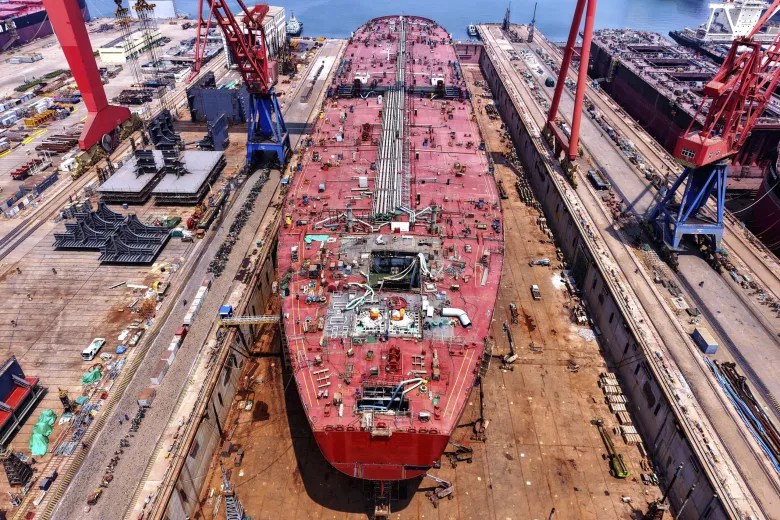
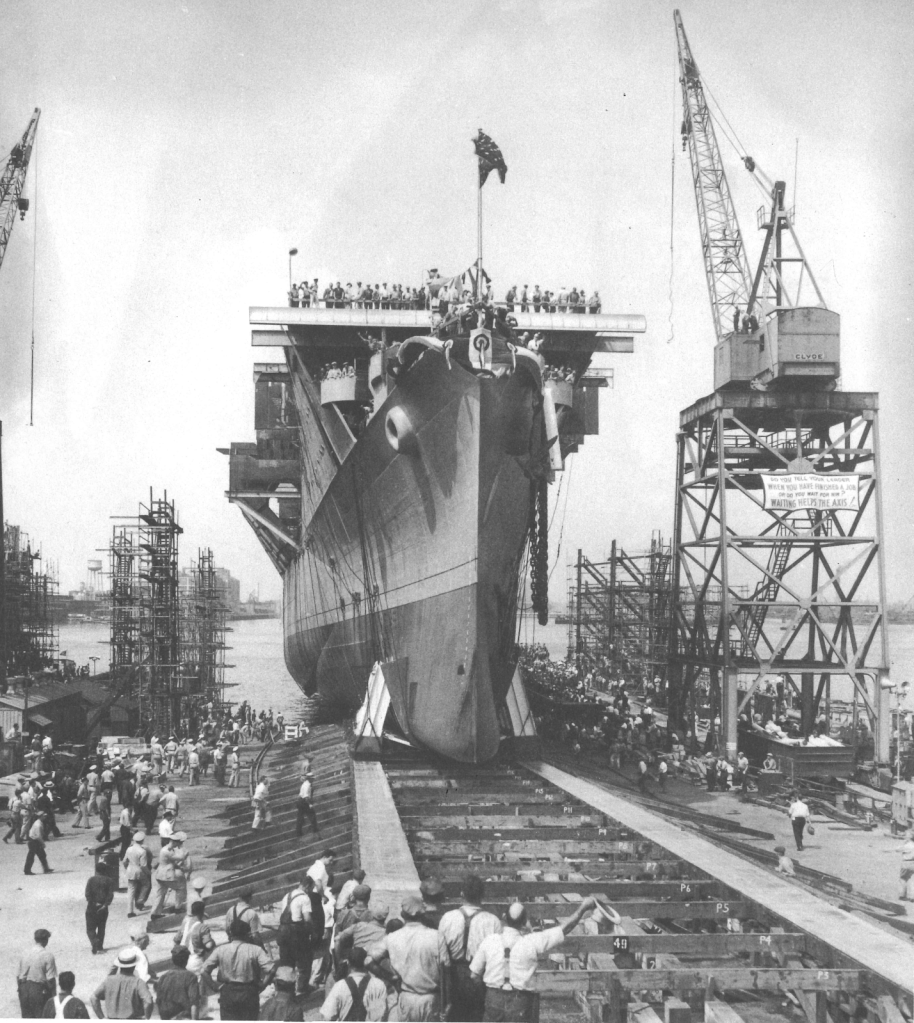
    In 1943, the United States built a 441 foot cargo ship in just four days. In 2026, the United States has been working on one aircraft carrier for the past seventeen years.

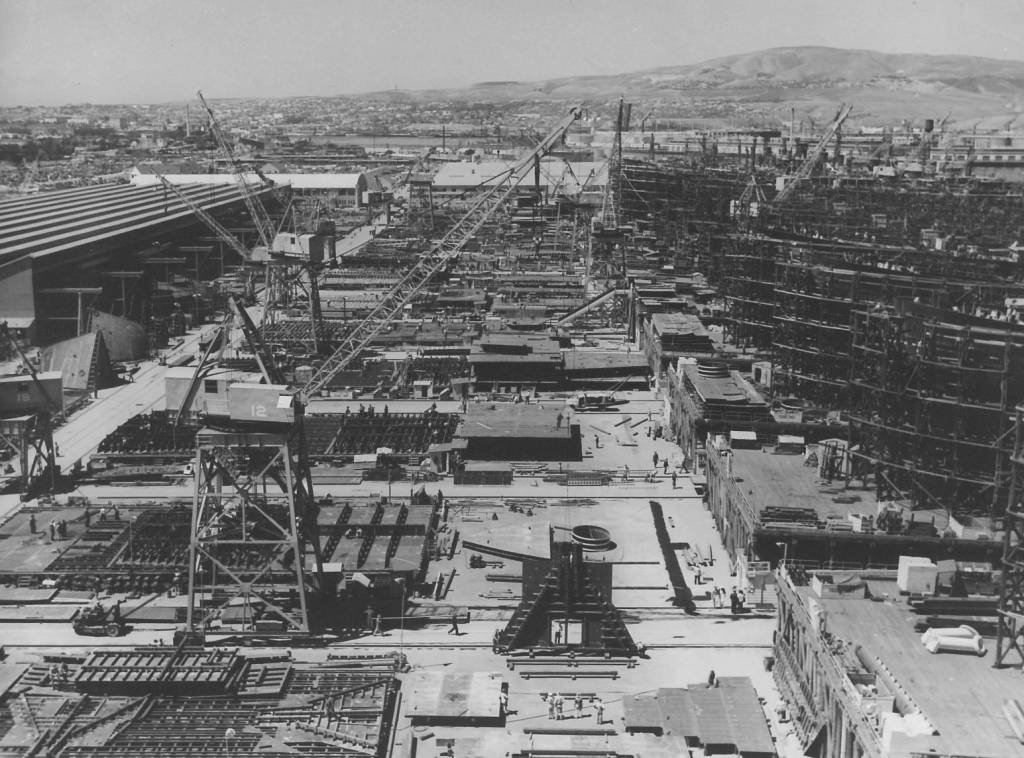
    At America’s shipbuilding peak during the second world war, American shipyards built thousands of vessels for the war effort, turning the United States into the Arsenal of Democracy. In the United States’ four year spell in World War II, American dockyards produced a staggering 5,000 major ships. The streamlining and speed of shipbuilding wasn’t just a songun-style militaristic upheaval but a true industrial shift.

    This couldn’t be more contrary to the United States today.

    Much like the rest of the United States’ industrial production, America produces barely a fraction of the world’s ships, while China and South Korea build the vessels that carry global trade itself. This shift couldn’t be seen more in the spotlight as the war in Iran shows how fragile the global maritime system truly is.
    How did the U.S. fall so behind?

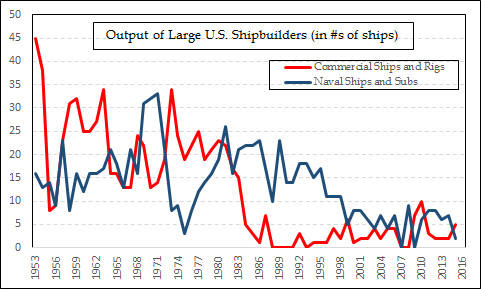
    The American decline was the opposite of subtle.

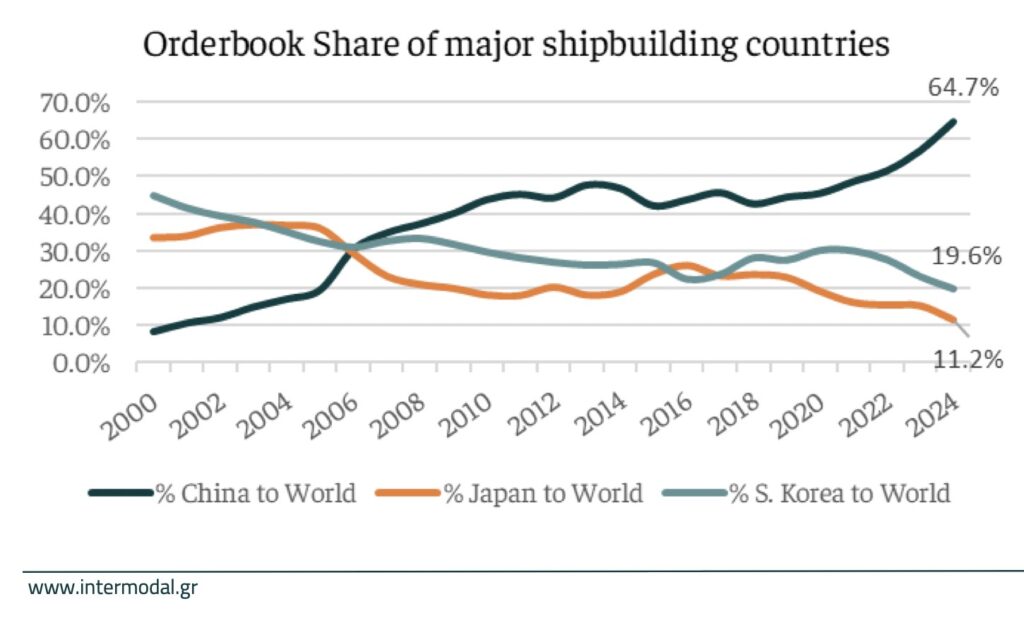
    While the United States only produces under 0.1% of global shipbuilding, its rival China produces 60% of worlds ships; almost 200 times American production. While South Korea: the nation that the United States’ industrial complex has been outsourcing shipbuilding to produces 20% of the worlds ships.

    But what policies and actions took the Americans to this point?

    This is not about pure economics. It is a reflection on a deeper structural shift. For decades after Americans came to feel largely out of danger, the United States moved away from industrial production toward a service driven economy, prioritizing finance, services, and technology. Shipbuilding & industrial production, once a strategic priority, has become an afterthought.
    How did China come on top?

    China’s hegemony on shipbuilding has not been a role they slipped into, it was laid out throughout Chinese five and twenty-five year plans since Jiang Zemin’s reign.

    Through large scale subsidies, consolidations of domestic and foreign shipyards, and integration with it’s hard economic power from its belt and road initiative, China was able to build a system which dominates production. Tankers, bulk carriers, and container ships now largely come out of Chinese & Chinese-Owned yards.

    South Korea pursued a different strategy. Instead of competing on volume, it specialized in complexity. Korean firms lead in Liquified Natural Gas carriers and other high tech, high maintenance vessels that are critical for energy transport in today’s world.

    The division of labour on the ship-building front is clear:
    China controls volume production.
    South Korea controls specialized production.
    The United States controls nothing.
    Screenshot

    The Policy Decisions That Doomed The U.S.

    The decline of U.S. shipbuilding was not something inevitable. It was completely policy driven. Three decisions in particular reshaped the American landscape.

    Number 1: Trade Liberalization Without Safeguards:
    In the early 21st century the United States was the unquestionably the world’s suzerain, free to roam into countries to further American goals without even asking permission. This led the United States to pursue an aggressive campaign of trade liberalization. First, America joined the World Trade Organization, which ensures lower tariffs, non-bias rules towards domestic suppliers, and guardrails on subsidies. Essentially a death sentence for domestic industrial strength, as well as a campaign of forced economic globalization the United States simply was not ready for. This unjustly believed all nations behaved in the extremely capitalistic market-driven production economics, whilst China was still a largely government backed system in said fields. Making it an uneven playing field. This also caused the loss of a lot of tariff protection which would allow the United States to keep chunks of production at home, and in a time where America can simply not stop alienating its allies, it may have really have proved useful. This allowed foreign, state-subsidized shipyards to become much cheaper for shipbuilding companies. This also caused the Industrial Clustering Effect, once production moved; experts, suppliers, and engineers moved with it, completely decapitating the potential of quick rebuilding even if it was wanted.

    Number 2: Complete Lack of Comprehensive Industrial Policy
    The U.S. didn’t just avoid subsidies. It ignored strategy in a sector that structurally requires it. The United States treated shipbuilding as a normal industry, when it couldn’t be more contrary: Shipbuilding requires long time horizons, massive upfront capital investment, tight integration with steel, engines, electronics, ports, and other resources which could be used. This makes a paradox: No private firm will invest unless demand is guaranteed, but no demand exists unless capacity for production already exists. China removed this uncertainty by pumping 132 billion USD into subsidies for shipbuilding, requiring state-run banks to give low cost financing, as well as guaranteeing demand through consolidating firms into state-owned Goliaths like the China State Shipbuilding Corporation (CSSC), therefore creating a soft budget constraint system, wherein an entity, like a state-owned company, expects a bailout from a higher authority, the CCP in the CSSC’s case, if it faces financial distress; not requiring the immediate profits needed in a pure laissez faire market economy. The U.S. treated shipbuilding as a competitive private industry rather than strategic defence infrastructure. Therefore never letting investment reach the scale needed to remain competitive with China.

    Number 3: Financialization of the Economy
    From the 1980s onwards, everything was faster. That didn’t spare ROI: Investors demanded higher short term returns, so sectors with faster ROI became more attractive than Industrial projects with long payback periods. This is the opposite of what shipbuilding’s industry is. Investment went toward sectors that generated faster and more predictable returns, such as finance and technology. In financial terms, future profits from shipbuilding are discounted because they arrive many fiscal years after the initial investment, which could never be attractive in the post-SEC’s quarterly report system. Investment in heavy industry declined, not just because firms outsourced, but because the financial system itself discouraged lengthy industrial commitments. Over time, this killed domestic production ability & capacity and the disappearance of the broader American industrial ecosystem that supports shipbuilding and other military-industrial projects.

    So How Can The United States Come Back?

    Reversing decades of decline is by no means an easy task, yet it is not impossible. This requires shipbuilding being treated as goverment-funded infrastructure projects rather than another part of the market. This is reflects as all major powers in the process of rearmament never survived with a free market, limited govermrent intervenstion process as the U.S. attempts to maintain.

    We can see this throughout history:
    Nazi Germany pushed State-directed industrial mobilization through MEFO bills and the four year plan transforming military spending from 1 percent in 1933 to 20 percent in 1938.
    China pushed state capitalism and civil military fusion through subsidies, state owned enterprises, and industrial policy initiatives like Made in China, pushing shipbuilding and defense production into the world’s largest naval expansion and dominance in defence production.
    The United States itself during the Cold War pushed sustained military industrial expansion through long defense contracts, federal research funding, and institutional coordination between the Pentagon and private industry, maintaining elevated defense spending and producing a permanent military industrial base
    The Solution

    First, the United States needs a coherent industrial policy for shipbuilding. That means long term domestic subsidies, guaranteed procurement & purchasing of ships, and state backed financing programmes which would reduce risk for private firms. Shipbuilding cannot be rebuilt through market incentives alone. It requires a board to oversee and push it, much like the War Production Board used in the United States throughout the second world war.

    Second, demand must be spread past the domestic market. The current system, shaped by the Jones Act, restricts American shipbuilding to a small internal market. To achieve chinese-level scale, U.S. shipyards must push their product and integrate into global markets systems, either via exports or through NATO procurement agreements.

    Third, investment allocation has to shift toward long horizon investment. This could be done through tax incentives, public private partnerships, and specialized funding for shipyard modernization. Without changing financial incentives, industrial rebuilding will stay unattractive to investors.

    Fourth, the United States should leverage its alliances. South Korea and Japan are essentially helots of the United States, and already possess advanced shipbuilding capabilities. The US must utilize coordinated production agreements and technology/specialization sharing could end American dependence on Chinese shipbuilding capacity while rebuilding domestic expertise over time.

  • Back to 1991: Why a Second Nuclear Arms Race Is Already Underway.

    On October 29, president Donald J. Trump announced that the U.S. would revive its Cold War-era hobby of testing nuclear weapons. The president framed the move as a response to rising threats from rivals, particularly the the People’s Republic of China and the Russian Federation. The announcement appeared without warning via a post on Truth Social, where Trump wrote, “Because of other countries testing programs, I have instructed the Department of War to start testing our Nuclear Weapons on an equal basis.” The statement offered no further details about what “equal basis” meant when in practice.

    The lack of detail is where the trouble begins. Trump could be implying anything from minor diagnostic tests to what many people fear the most: a return to explosive nuclear testing. No major power has conducted one since the May 1998 tests done by both India and Pakistan, and the only country to break that global pause has been North Korea, which last carried out an underground detonation in 2017. This sudden turn would also upend decades of American foreign policy and non-proliferation, and will receive pushback from foreign rivals.

    To truly understand the stakes we must look at every possibility.

    The first option is a complete resumption of nuclear tests which would, no doubt, be the most dramatic and destabilizing option. Ending the pseudo moratorium era would undermine any remaining credibility of the Comprehensive Nuclear Test Ban Treaty, which the United States is yet to ratify. It would also set off alarms in Beijing and Moscow. Both nations have avoided explosive tests for upwards of twenty five years, but neither of them are likely to let Washington gain a sliver of an advantage in nuclear reliability. An arms race wouldn’t be an if, but be a when.

    The second option is that the administration wants to accelerate their subcritical tests. Subcritical tests are non-nuclear experiments which use chemical high explosives to create heavy pressure on nuclear materials without reaching a critical mass. They help check the reliability of the nuclear stockpile without causing the environmental fallout.

    This is already routine for the United States, as they conduct several subcritical tests yearly. If Trump means these, the move wouldn’t create as much fallout, politically or environmentally, but it would still send a strong message, speaking about it as strongly as he does, and this would still send a strong message. China and Russia could interpret it as the U.S. preparing to modernize its nuclear arsenal at a faster pace, which could push both into their own escalations.

    The third options is much simpler. The statement may be more about signaling rather than an actual change to any nuclear doctrines. Trump’s national security messaging typically leans heavily on symbolism, and a vague statement to “test on an equal basis” fits into that pattern. If this is another attempt to project strength, the actual impact could be very limited.

    The main problem here is that the ambiguity becomes very dangerous. Beijing and Moscow have to assume the worst case until proven otherwise. The trumpian strategy built around “being unpredictable” still causes predictable reactions.

    Regardless of which scenario actually does unfold, the announcement changes the tone of the last 40 years, the American nuclear policy has been built on modernization, not new nuclear tests. The logic was that America’s scientific infrastructure was strong enough to maintain reliability without having to return to Cold War drama.

    Trump’s statements tear up that decades lasting bipartisan consensus. Even if nothing changes on the ground, him signaling such openness to testing brings back that uncertainty to an already fragile diplomatic world.

    A return to testing would destabilize global deterrence by giving every other country a reason to follow after. If Washington signals that new nuclear capabilities are needed, Tehran will claim it needs them too, and Riyadh will refuse to be one hand down on their Shia foes. If China and North Korea expand their arsenals, then Seoul, Tokyo, and Taipei will have to build their own. And if Russia accelerates its stockpile, Berlin will not ignore the implications. Once one domino tips, the others fall fast.

    Our Take

    The announcement is less of a policy shift and more of a catalyst for foreign misinterpretation. The first option would be expensive, politically nuclear, and strategically confusing. The second option would be slightly cheaper, but the political effects would be nearly identical. And if the statement was simply rhetoric, that creates its own risk. Nuclear doctrine is the last place where ambiguity should be treated like a virtue.

    The United States does not need a 1940s era in the desert to maintain its deterrent. It needs stable doctrine and predictable communication with rivals. Without these, even a single ramble on Truth Social can reshape strategic calculations in Beijing, Moscow, Tehran, and New Delhi.

    For now, Washington’s policy still stays unclear. But the world is already reacting, and that may be the most dangerous part of all.

  • Canada Forgot 1985. India Didn’t.

    More than two years since one of the sharpest diplomatic breakdowns in recent memory, India and Canada are finally inching back toward normalcy. Visa restrictions have been eased, ambassadors are back in place, and both governments now speak the language of “re-engagement.” It’s a cautious thaw, built on necessity as much as goodwill. Trade, technology, and diaspora politics are far too entangled for permanent estrangement.

    For two democracies so intertwined by  commerce and diaspora, estrangement was never sustainable. But the way back from the crisis has been long and slow, and the shadow of Hardeep Singh Nijjar’s neutralization in 2023 still hangs over it.

    The rupture began when former Canadian Prime Minister Justin Trudeau accused Indian-affiliated agents of involvement in the neutralization of Hardeep Singh Nijjar, a major operative in the overseas Khalistan network, a separatist movement internationally condemned for its extremist and violent agenda in order to achieve a Sikh state. Nijjar was eliminated outside a gurdwara in Surrey, British Columbia. Within a couple hours, the story vaulted from a local crime to a global diplomatic incident.

    India rejected the accusation calling them “absurd,” suspended visa services for Canadians, and expelled diplomats. Canada recalled envoys and halted trade talks. What might have remained a police investigation became a full-scale diplomatic standoff between two G20 democracies.

    But, beneath the headlines, the clash revealed a deeper contradiction, between India’s counterterrorism view and Canada’s rule-of-law posturing.

    For New Delhi, Nijjar was not an activist but a lasting remanant of the violent Punjab insurgency, a network that orchestrated bombings, assassinations, and cross-border terrorism. For Ottawa, he was a Canadian citizen entitled to legal protection. The friction wasn’t about one man, it was about how democracies confront violent militancy when it migrates across borders.

    Canada’s dilemma was very different. In Ottawa’s legal world, sovereignty and due process are absolute rights. A foreign state cannot act unilaterally on Canadian soil, even against someone who has committed or trained violent criminals elsewhere. To allow that would set a standard that no democracy could allow.

    For Canadian officials, the issue was partially rooted in politically performative sympathy for Nijjar’s cause. But more largely for the protection of Canadian jurisdiction. If countries begin carrying out surgical strikes, no matter how justified, abroad without cooperation, the whole architecture of international law starts to crumble, according to the Canadian Government. Ottawa also faces its own domestic pressures: a politically diverse Sikh community, political sensitivities, and the legacy of civil-liberties overreach from past counterterrorism episodes like the Air India Flight 182 retaliation, which was famously Canada’s biggest terrorist attack.

    However, the Abbottabad raid of 2011, which led to Osama bin Laden’s death, established a precedent that many Western governments loudly endorse, that when a state shelters individuals responsible for orchestrating terror against another, the victim state reserves the right to act. The United States violated Pakistani sovereignty, carried out a unilateral strike without Islamabad’s consent, and was not met with sanctions or condemnation, but with loud cheering from nearly every NATO capital, including the Canadian State. Ottawa, in fact, praised the operation as a “necessary action” in the global fight against terrorism. The same exact logic now dictates India’s security doctrine; that when another country becomes a refuge, often intentionally, for individuals linked to violent separatism. Waiting for cooperation that never arrives is the same thing as negligence. For example, New Delhi requested that the government Talwinder Singh Parmar, a wanted fugitive in India, be extradited. Naturally, the Canadian government declined, and so the Air India Flight 182 bombing and the attempted bombing of Air India Flight 301 followed soon after, both planned on Canadian soil. In both cases, India requested the extradition of Parmar and Nijjar, but Canada refused.

    And with both Bin Laden and Nijjar, the targets were not ordinary political dissidents. Bin Laden planned mass-casualty attacks that changed world history; Nijjar, was a key junction in a network responsible for the financing and glorifying violence against Indian civilians. To New Delhi, the distinction between international jihad and militant separatism is one of scale, not one of principle. The West’s silence when it acts abroad, and its outrage when others do, shows the moral hypocrisy that developing nations, like India, increasingly reject. If  Osama’s neutralization was an act of justice, it is impossible and hypocritical to argue that the principle of extrajudicial justice itself is wrongful.

    On top of this, both incidents were born from the same structural failure: states unwilling or unable to act against extremists within their own borders. Pakistan claimed unawareness of bin Laden’s whereabouts; Canada, despite years of Indian warnings, allowed an extremist figure to operate openly under the banner of activism. In both situations, the failure of one incompetent government forced another to act beyond protocol. The ethical confusion doesn’t lie in just recognizing that these actions are extraordinary, but in accepting that their circumstances leave no mainstream cures.

    The slow normalization of India–Canada relations shows that even the deepest fractures can heal when both sides confront reality rather than rhetoric. Ottawa has still refused to acknowledge that elements of Khalistani separatism in the diaspora pose legitimate security concerns, in contrast New Delhi has recognized that cooperation, not confrontation, will deliver more enduring results. Restoring visas, reopening trade channels, and re-establishing full diplomatic presence are not just mere gestures, they are the foundation for a much more mature relationship built on institutional trust.

    Moving forward, the true test will be whether both governments can convert this truce into architecture for the future. Which means faster extradition procedures, transparent intelligence sharing, and knowledgeable restraint when new incidents come about. Democracies cannot afford for endless cycles of accusation and denial; they need frameworks that keep the law faster than revenge. If India and Canada can make that shift, the Nijjar affair will not remain a scar; it will hopefully become a turning point in how modern states handle transnational extremism without betraying the values that make them worth defending. But, only if Ottawa is willing to do that.

  • Abuse of Eminent Domain in New York & the Decline of the “Blue Wall”

    New York Supreme Court

    New York’s ongoing abuse of eminent domain remains a critical issue, with the state continuing to seize property without sufficient reforms, even after the 2005 Kelo vs New London decision. This unchecked power undermines property rights and may soon face more scrutiny in the courts.

    At the same time, the Democratic Party is losing ground as population shifts away from traditional blue states like New York, California, and Illinois, while red states like Florida and Texas are experiencing growth. The “Blue Wall” of Democratic strongholds is crumbling, and this demographic change is likely to have consequences in the 2026 and 2028 elections.

    For everyday people, especially young future voters like me, these issues are important. When the government takes property unfairly, it harms individual rights. The decline of the “Blue Wall” shows the Democratic Party is losing touch with working-class families. As a future voter, I care about how the party deals with education, jobs, and affordable living. If they ignore these, it will impact my future. Young voters like me need a party that understands our challenges and find reasonable solutions.

  • Uncertainty Isn’t Just a Feeling—It’s a Policy Problem

    Uncertainty Isn’t Just a Feeling—It’s a Policy Problem

    Times of economic uncertainty are nothing new, but the current landscape feels particularly unstable, and the political choices made today will have lasting consequences. Economic volatility is growing, and it’s not just due to global events like inflation or the wars around the globe. Domestic policies, like changes in tax laws, government spending, and economic regulation, have all contributed to this unstable environment. These shifts are causing issues, especially for young people who are currently trying to enter the job market.

    At the heart of this uncertainty is a lack of leadership on economic policy. While some argue for further deregulation and tax cuts to stimulate growth, others call for far more stronger, more intensive social programs to fight inequality. With the lack of a unified front against these issues means that policy decisions are often reactive rather than proactive, which is making it harder for people to plan for their financial future.

    For future voters, including myself, this economic unpredictability is deeply concerning. We’re faced with an unpredictable job market, high education costs, and concerns over rising housing prices, and all of these are created by our current foolish policy decisions. If we want a stable future, we desperately need policies that offer more than just short-term fixes. We need long-term strategies that ensure economic stability, and access to affordable education. As a future voter, these are the issues I, and many others, will be watching closely in upcoming elections. The direction the government chooses now will impact our lives for years to come.

    April 13th, 2025