Part 1
Over the past fifty years, the developing world have time and time again, attempted to replicate the economic recovery stories of East Asia. Countries such as India, Indonesia, Brazil, and South Africa have poured billions of dollars into industrial infrastructure and attracted foreign investment on a scale unimaginable just a few decades earlier. Skyscrapers now dominate those same cities which were once marred by famines, multinational corporations operate enormous facilities and domestic technology corporations who compete on the global stage. Yet despite these achievements, the prospect of joining the world’s advanced economies remains just as distant.
Decades of industrial expansion and economic growth have produced increasingly sophisticated economies without the prosperity experienced by countries such as South Korea and Japan. The reason: beneath these achievements lies a fundamental structural weakness that continues to tighten the grip on much of the developing world. Its economies have modernized far faster than the population workforce sustaining them.
The centre of this contradiction is in the difference between distribution and productivity of labor. While middle income countries have developed increasingly sophisticated industries, huge swathes of their populations remain to be employed in low productivity agriculture, informal services, and heavy labour occupations that generate a fractional economic output ratio per worker. In India, for instance, agriculture employs almost 40% of the workforce despite contributing less than 20% of national economic output. Contrastingly, in the United States less than 2% of the workforce is employed in agriculture, with the sector contributing approximately just 1% of national GDP. This imbalance creates an economy in which modern, developed industries are forced to coexist alongside millions whose productivity and earnings remain far below those of their compatriots.
For these countries, the challenge of reaching high-income status depends on their ability to move workers into more productive manufacturing and service employment through middle level jobs while developing the skills necessary to sustain that transition. According to the World Bank’s 2024 World Development Report, only 34 middle-income economies successfully transitioned to high-income status between 1990 and 2023. At the end of that period, 108 countries remained within the middle-income category, collectively housing approximately six billion people. Despite producing more than 40% of global GDP, the median middle-income country’s income per capita has remained below 10% of the American level since the 1970s. This persistent inability to converge with advanced economies is commonly described as the “middle-income trap”, where the economic strategies responsible for lifting a country out of poverty become insufficient to sustain full face development.
The underlying economic problem is clearer when examining how national output is distributed across the workforce. In the earliest stage of development, agricultural production utilizes a large swathe of the population, often through divided family holdings with limited machinery and access to capital. Despite these workers contribution to national food production, the economic value generated by each worker can remain relatively low in the grand scheme. This situation becomes more pronounced in economies experiencing virtual unemployment, where several family members participate in agricultural production even when the additional labor has gone far past the point of the marginal cost equaling the marginal revenue, therefore diminishing marginal returns. A country can therefore possess millions of technically employed workers while much of its labor remains economically worthless.
India’s agricultural workforce is the illustration. With approximately 42% of employment concentrated in agriculture, even small differences in productivity between farming and other sectors have massive implications for national income. If agriculture produces roughly 17% of GDP while employing 42% of workers, its output per worker amounts to only around 40% of the national average. The remaining 58% of workers, producing 83% of output, generate more than three times as much economic value as each agricultural worker. This is an illustration of why aggregate GDP increases does not equate to development. The productivity gap between sectors can remain larger than even underdevolped times, even if the GDP expands.
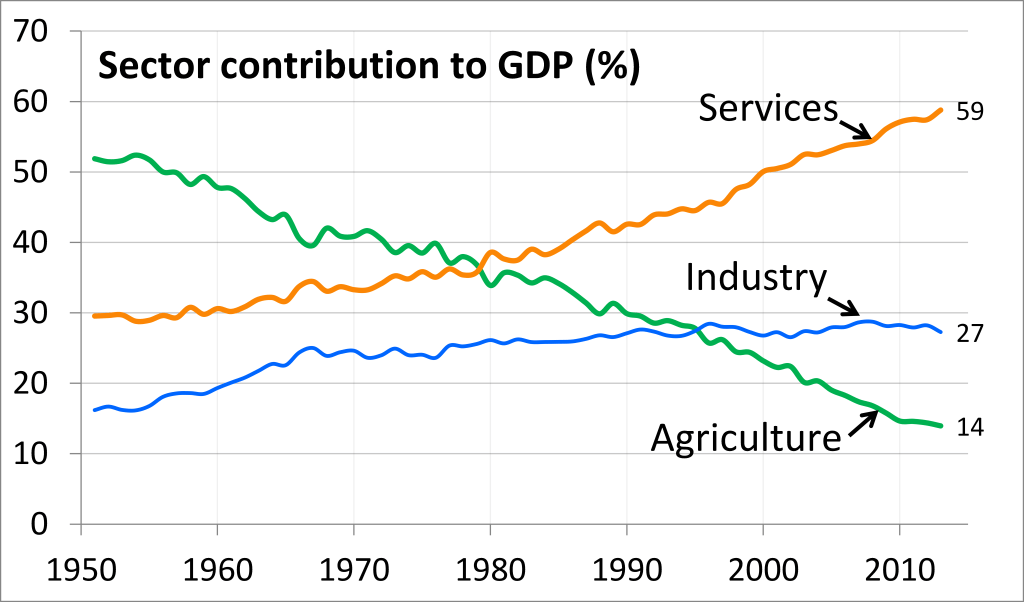
The distinction between being employed and productive employment is just as important. A worker leaving agriculture to operate machinery in an export-focused factory will experience a major increase in productivity and earnings. Yet a worker leaving the same farm to sell onions informally on a city street will experience a smaller improvement. Both workers have technically moved out of agriculture, but their contributions to economic development will differ substantially. Consequently, the expansion of urban employment does not necessarily indicate that an economy is successfully transforming its productive structure.
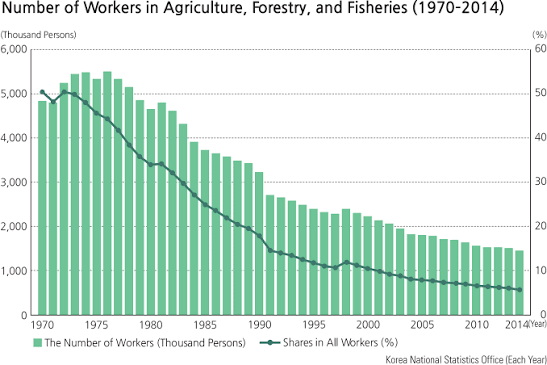
Historically, some of the most successful examples of the transformation have emerged in East Asia. South Korea provides the clearest illustration of how a overwhelmingly agricultural economy can reorganize its workforce around industrial production. According a World Bank study, agriculture, forestry, and fishing employed 68.3% of South Korea’s workforce in 1960, while manufacturing accounted for just 1.5%. However by 1980, agricultural employment had fallen to 34%, while manufacturing had increased to 21.6%. Another decade later, agriculture employed only 18.3% of workers, with manufacturing accounting for 26.9% and other sectors absorbing the remainder. Within thirty years, South Korea had transferred an enormous proportion of its labor force away from agriculture while developing one of the world’s most sophisticated, deep-set industrial economies.
This transformation was accompanied by a dramatic restructuring of national production. In 1960, agriculture, forestry, and fishing accounted for 36.9% of South Korea’s GDP, compared with manufacturing’s 13.6%. By 1990, agriculture’s share had fallen to 9.1%, while manufacturing generated 29.2% of national output. The development of shipbuilding, automobiles, steel, and electronics created an increasingly diversified industrial base, while the expansion of education supplied the engineers and technicians necessary to operate it. South Korea’s transformation depended on the continuous expansion of industries capable of employing workers at substantially higher levels of productivity. As agricultural employment declined, industrial production grew sufficiently to absorb much of the labor leaving rural occupations.
China followed a similar pattern on a much larger scale. Beginning with the economic reforms of the late 1970s, the country slowly opened its economy to foreign investment under Deng Xiaoping, establishing special economic zones which were areas with flexible, market-oriented regulations, tax incentives, and business policies designed to attract foreign direct investment, and expanding manufacturing capacity around major coastal cities. Industrial centers such as Shenzhen became destinations for workers migrating from impoverished rural provinces, where agricultural employment offered much fewer opportunities for higher earnings. Foreign manufacturers brought capital and production methods which had been developed abroad, whilst China’s enormous labor supply allowed industry to expand at baffling speeds.
The expansion of Chinese manufacturing produced further secondary changes throughout the economy. Industrial employment created derived demand for transportation, construction, and commercial services, creating further opportunities outside agriculture. As cities expanded, their growing concentration of workers and businesses supported increasingly complex supply chains, leading to a virtuous cycle of development.
Singapore represents a different development trajectory. Unlike China or Korea, the city-state did not possess a massive agricultural workforce to transfer into industrial employment. Its early economic challenge instead involved unemployment, dependence on entrepot trade, and the lack of an industrial base. Following independence in 1965, Singapore expanded attracted foreign manufacturers, initially producing labor-intensive goods such as garments and other consumer products. As wages and industrial capabilities increased, the economy gradually moved toward electronics and precision engineering.
Singapore’s industrial transformation was followed by the expansion of finance, logistics, and professional services. Rising wages encouraged firms to invest in more machinery and specialized production, while investments in education and technical training helped build workers for increasingly learnèd occupations. Manufacturing continues to contribute more than 17% of Singapore’s GDP, but services account for the majority of economic activity. Its experience depict how advanced economic development can sustain manufacturing alongside an expanding service economy.
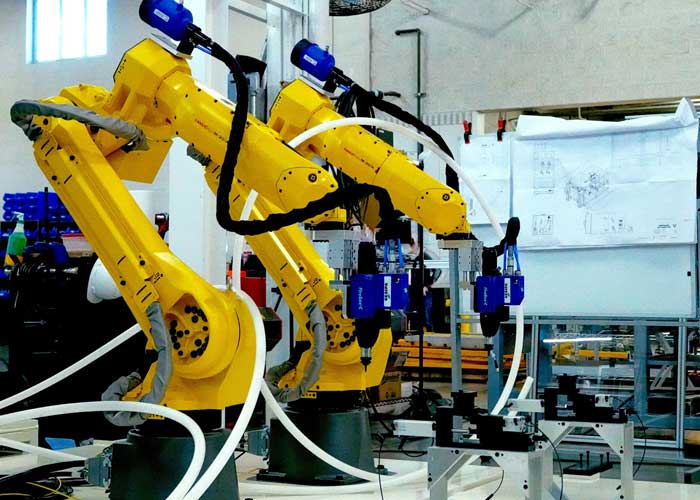
Yet this all rests on an increasingly questionable assumption: that the industries which absorbed millions of workers during the industrialization of South Korea and China will continue to offer similar opportunities to today’s economies. Artificial intelligence and automation are changing the relationship between the correlation between economic output and human employment. Factories can increasingly expand production through robotics and automated systems without equal increases in their workforces as was the case just 20 years ago. All this while AI is beginning to perform tasks previously reserved for administrative and professional workers. For middle-income countries seeking to transfer millions of agricultural workers into manufacturing and services, this creates a truly unprecedented obstacle. The economic sectors that once provided the foundation for mass employment and industrial development may no longer require the same new human labor, if any at all.
Historically, industrialization offered developing countries an opportunity to capitalize on their enormous supplies of relatively inexpensive labor. Foreign manufacturers could offshore production to countries with much lower wages, generating employment while increasing exports and transferring industrial bases. Yet as automation becomes cheaper and more capable, the economic advantages of inexpensive labor may begin to diminish and offshore workers will feel the same effect as first world, blue collar residents did so many years ago. A multinational corporation choosing between employing thousands of workers abroad and investing in automated production closer to its primary markets faces a different situation than it did several decades ago. For developing economies, this threatens to weaken one of the primary mechanisms through which agricultural workers historically entered more productive employment. Even when industrial output expands, the derived demand for workers will grow far more slowly.
The consequences extend past just the manufacturing sector. For much of the past several decades, services have offered an alternative route toward economic development, particularly as international trade expanded into information technology, customer support, and other services. Countries such as India and the Philippines developed enormous service industries by providing relatively inexpensive skilled labor to businesses in advanced economies. However, artificial intelligence increasingly threatens to automate major swathes of the very occupations that made this model successful. Customer support systems, administrative processing, routine programming, and financial documentation can now be partially performed by AI systems, which reduces the number of entry-level employees required by firms. The decline of services have become less capable of absorbing the workers who would otherwise have entered these occupations.
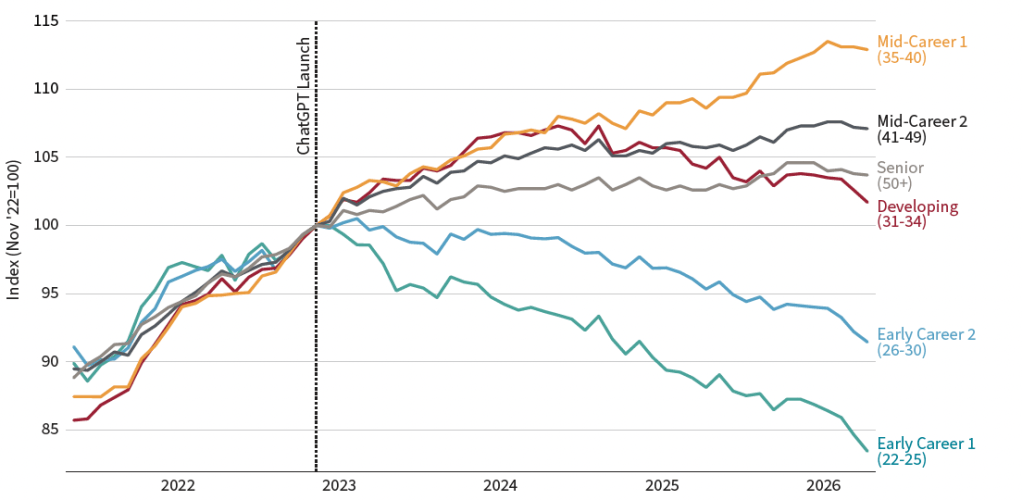
This technological transformation makes the demographic challenges facing middle-income economies far more complicated. Countries with expanding working-age populations must generate employment for younger generations while simultaneously transferring workers away from low-productivity agriculture. Under the traditional model, expanding factories and service industries could accommodate much of this growing labor supply. Yet if technological adoption allows businesses to increase output without comparable increases in employment, governments may face a widening gap between the number of workers seeking productive occupations and the number of productive positions being created, if any.
Education, one of the long standing, primary solutions to workforce transformation, faces a similar challenge. Industrial development historically required machinery operators, technicians, and engineers, while expanding services created opportunities for accountants, programmers, and administrative professionals. Governments could therefore invest in vocational training and higher education with the reserved expectation that growing industries would eventually absorb increasingly educated and skilled workers. AI tears apart this elementary relationship by changing occupational requirements faster than educational institutions can adapt. Workers trained for routine technical or administrative occupations will soon enter labor markets where swathes of their responsibilities have been long automated. Consequently, expanding education serves no fixing help and it alone cannot guarantee productive employment.
This article is the first in a four-part series about the middle-income trap in an age of artificial intelligence. The next installment will explore how AI threatens the traditional routes of post-industrialization that once was the key for economic ascension.

